What the Menopausal Workers’ Fairness Act Would Require Employers to Do
The bill introduced July 2026 would require employers with 15+ employees to provide accommodations for menopause. It mirrors protections for pregnancy, not disability.
Representatives Debbie Dingell and Yvette Clarke introduced the Menopausal Workers’ Fairness Act on July 14, 2026, creating a federal framework for workplace accommodations for menopause-related symptoms. The bill would apply to employers with 15 or more employees and establish four presumptively reasonable accommodations: the ability to carry and drink water as needed, additional restroom breaks, the option to alternate between sitting and standing, and breaks to eat or drink. The Equal Employment Opportunity Commission would issue regulations within a year to provide guidance on what menopause-related limitations qualify for protection and to potentially expand the list of accommodations.
The bill addresses a gap in federal employment law. According to Dingell’s office, menopausal symptoms affect a significant portion of employees and could cost U.S. companies billions of dollars annually through reduced productivity, increased absenteeism and premature loss of talent if left unaddressed. Currently, women seeking accommodations for menopause must often pursue them under the Americans with Disabilities Act, a higher legal bar than the Pregnant Workers Fairness Act sets for pregnancy-related requests. The new legislation would lower that threshold by treating certain accommodations as reasonable without requiring employers to individually assess their feasibility.
Four accommodations made presumptively reasonable
The bill specifies four accommodations that employers could not refuse without proving undue hardship: carrying and drinking water as needed, additional restroom breaks, alternating between sitting and standing, and breaks to eat or drink.
The presumptively reasonable standard means employers cannot demand extensive medical documentation before providing these accommodations. As one employment law analysis noted, this imposes a lower documentation threshold than the Americans with Disabilities Act typically requires: individualized analysis or documentation would be minimal for the four specified categories.
The EEOC would have authority to add more accommodations through regulation. The commission would also provide examples of known menopause-related limitations and guidance on when supporting documentation may be requested.
The bill also protects workers from forced leave. An employer could not require a woman to take medical leave if another reasonable accommodation would allow her to continue working. Medical information related to menopause would remain confidential under the bill, following protocols similar to existing ADA and FMLA requirements.
28 states have introduced menopause legislation
As of 2026, 28 of 50 states introduced menopause-related bills, with 10 states enacting a total of 21 bills by August 2026. Eight of the 28 bills newly introduced during 2026 have already been signed into law.
How it mirrors the Pregnant Workers Fairness Act
The Menopausal Workers’ Fairness Act adopts the legal structure of the Pregnant Workers Fairness Act. Both use the EEOC charge and Title VII remedy structure for enforcement, meaning complaints would be filed with the EEOC and follow the same procedures as sex discrimination claims.
The key difference between this approach and existing law is the presumption about reasonableness. Under the ADA, employers must assess whether an accommodation creates undue hardship on a case-by-case basis. The Menopausal Workers’ Fairness Act presumes that the four listed accommodations are reasonable, placing the burden on the employer to demonstrate that providing them would cause substantial cost or operational difficulty. This reversal of the burden mirrors the PWFA approach and represents a meaningful shift from how menopause accommodations are currently evaluated.
The bill also offers employers damages protection when they make good-faith efforts to engage in interactive processes with workers, similar to protections built into the PWFA.
The federal policy gap the bill would fill
The federal bill enters a landscape marked by an explicit gap in federal law. The Labor Department has acknowledged that federal workplace laws do not explicitly cover menopause itself. While Biden-era EEOC regulations implementing the Pregnant Workers Fairness Act aimed to apply that law’s protections broadly to reproductive health conditions, potentially including menopause, political uncertainty has complicated the picture. The Trump administration’s EEOC chair signaled intent to narrow the focus of reproductive health protections.
This ambiguity at the federal level has driven state action. As of March 2026, at least 16 menopause-related bills had been introduced since the start of the year, up from only three in 2025.
A wave of state menopause bills in 2026
The federal bill enters a landscape transformed by rapid state action. As of 2026, 28 of 50 states have introduced menopause-related legislation. Ten states have enacted a total of 21 menopause-related bills across workplace accommodations, insurance coverage and education. Three bills were signed into law in Illinois in August 2026 alone.
State bills typically address three areas: workplace accommodations and anti-discrimination protections, insurance coverage for menopause-related medical treatments, and education requirements for healthcare providers and employers. Illinois enacted three bills in August 2026, including one addressing all three areas. New Jersey enacted legislation mandating insurance coverage for menopause treatments in January 2026. Virginia passed a law in April 2026 requiring state-regulated health plans to cover treatment for perimenopause and menopause, though a separate workplace accommodation bill was vetoed by the governor.
Other states have pursued narrower approaches. Maryland enacted omnibus menopause bills in May 2026. Pennsylvania marked menopause awareness events in October 2025. Maine required state health department informational materials in July 2025. Rhode Island passed workplace protections in June 2025. Philadelphia amended its local ordinance in December 2025 to cover menopause-related conditions. Oregon and Washington cover certain menopause-related treatments for some populations; Washington’s bill passed in July 2025, Oregon’s in August 2025.
Several states advanced additional measures. New York has two pending proposals: bill A5436 would ban job bias and require accommodations for menstruation, menopause, and perimenopause-related conditions, while bill S9244 would mandate five days per year of paid time off for menopause symptoms. California’s governor vetoed insurance coverage bills in 2024 and 2025, calling for a narrower proposal to better balance cost concerns with access to care.
A federal law treating menopause like pregnancy would establish a clearer path for workers to request and receive help.
What’s at stake for women’s careers
If the Menopausal Workers’ Fairness Act becomes law, it could reshape how employers handle menopause-related requests. Currently, women often either suffer symptoms at work in silence or attempt to secure accommodations under medical leave policies and the ADA, a process that can be slow, uncertain, and tied to formal disability determinations. A federal law treating menopause like pregnancy would establish a clearer path for workers to request and receive help.
The legislation also addresses a gap in how the law treats common life events affecting women’s careers. Pregnancy accommodations now have explicit federal protection. The bill would extend comparable protection to menopause, which often affects women in midcareer, when they hold senior roles and bear significant workplace responsibilities. Federal protections could prevent women from leaving the workforce during years when career advancement accelerates.
What’s at stake for health coverage and treatment
State menopause bills indicate growing demand for health insurance coverage of menopause-related treatments. Many health plans currently do not cover menopause-related medical treatments as routine care. State mandates are beginning to change this. Illinois, Louisiana, Oregon, and Washington mandate coverage for menopause treatments; New Jersey joined this group in January 2026; and Virginia passed insurance coverage in April 2026.
The federal bill does not directly address insurance coverage, focusing instead on workplace accommodations.
The timing of both state activity and federal legislation suggests sustained momentum on menopause policy, particularly following the FDA’s removal of the black box warning on estrogen products, which allows patients and doctors to make treatment decisions without the caution that had previously limited prescribing.
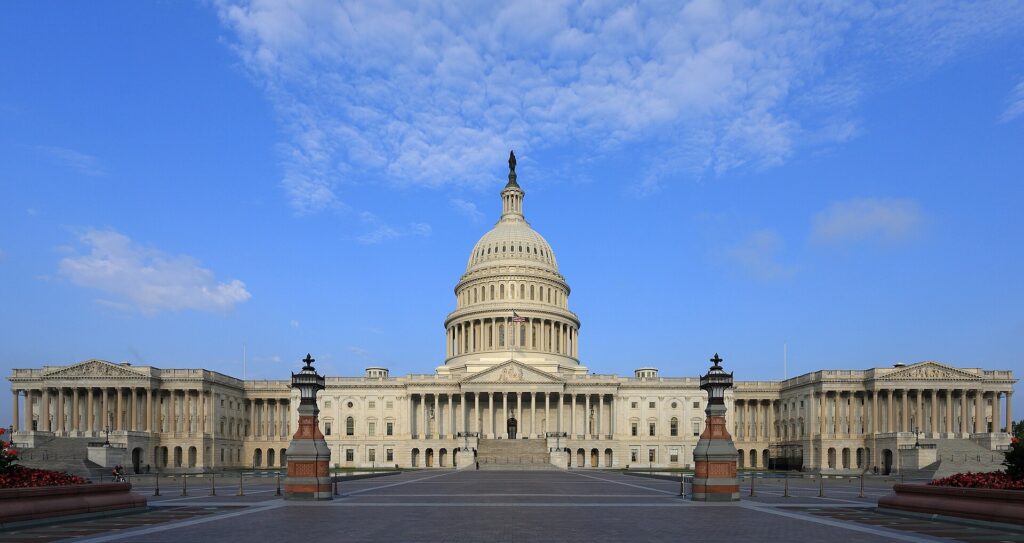
Photo: Martin Falbisoner · CC BY-SA 3.0 · via Wikimedia Commons