
SBA’s 2025 Final Rule Clarifies Ownership Control for Women-Owned Business Contracts
The SBA's January 2025 final rule clarifies ownership control, streamlines certifications and sets new application standards for women trying to access federal contracts.
The Small Business Administration overhauled its Women-Owned Small Business (WOSB) Federal Contract Program with a final rule effective January 3, 2025, clarifying eligibility requirements and changing how certifications work. The changes affect how women entrepreneurs must demonstrate and maintain ownership control, how they submit documentation, and how quickly the SBA will review applications. They come as women-owned businesses continue to undershoot the federal government’s 5 percent contracting goal though the gap has narrowed in recent years, receiving only 3.44 percent of all federal contract awards in fiscal year 2024.
The WOSB program aims to level the playing field by reserving certain federal contracts for certified women-owned firms in industries where they remain underrepresented. Federal contracts represent one of the most stable and recurring sources of revenue available to small businesses, but accessing them requires navigating a certification process and maintaining strict compliance with ownership and control requirements. The January updates to these requirements clarify what the SBA expects from business owners and how the certification process will function going forward, while also raising questions about practical implementation.
What the WOSB Program Does and Why It Exists
The WOSB Federal Contract Program, administered by the SBA, limits competition for certain federal contracts to certified women-owned small businesses in industries where the SBA determines they are underrepresented or substantially underrepresented. Rather than compete in open bidding against all contractors, certified WOSBs can pursue set-aside contracts—reserved opportunities—in designated industries identified by NAICS codes. The program also allows contracting officers to award sole-source contracts to economically disadvantaged women-owned small businesses (EDWOSBs) without competitive bidding when certain conditions are met.
To participate, a business must be at least 51 percent owned and controlled by women who are U.S. citizens, meet the SBA’s small business size standards for its industry, and have women actively managing day-to-day operations and making long-term strategic decisions. EDWOSBs face additional financial thresholds: personal net worth under $850,000, adjusted gross income of $400,000 or less averaged over three years, and personal assets of $6.5 million or less. These certifications apply only to federal contracting; they do not extend to private sector opportunities.
The program was established because women-owned businesses have long represented a substantial share of small businesses—30 percent of all small companies, according to a 2014 Senate report—yet have historically captured a far smaller share of federal contracting dollars. In fiscal year 2024, women-owned businesses received $26.64 billion in federal contracts across 13,957 companies—representing only 3.44 percent of all federal contracting dollars. The federal government has set a goal of directing 5 percent of contracting dollars to women-owned businesses; a 2014 Senate report found it had never met that goal, and WOSB awards remained below 5% in each of the last four fiscal years, though the gap narrowed from 3.13% in FY 2021 to 3.44% in FY 2024.
Women-Owned Small Business Federal Contracting in FY 2024
Women-owned businesses received $26.64 billion in federal contracts in FY 2024, representing 3.44% of all federal contracting dollars across 13,957 companies. This fell significantly short of the government’s 5% goal; the gap has narrowed in recent years, from 3.13% in FY 2021 to 3.44% in FY 2024, though a 2014 Senate report found the government had never met the goal.
The January 2025 Rule Changes: Full-Time Control and Notification
The SBA’s new rule clarifies and tightens requirements around how women owners must control their businesses. The updated rule now explicitly requires that qualifying owners devote full-time to the business during its normal business hours and cannot engage in outside work that would prevent proper control. The SBA aligned this language with its standards for service-disabled veteran-owned small businesses (SDVOSB) programs to create consistency across multiple SBA contracting programs.
What changed in practice: under the previous rule, ownership and control requirements existed but were less explicit about outside employment. Under the new rule, if an owner takes a second job or significant outside work after certification is granted, they must notify the SBA in advance. This notification requirement applies specifically to employment that begins after January 3, 2025. Existing WOSB-certified owners who already hold their certification are not retroactively affected by this requirement; the notification obligation only applies if they begin new outside employment after the rule took effect.
The change reflects a broader SBA enforcement approach across small business programs, moving toward tighter documentation of ownership control and more explicit monitoring of owner activities. For women entrepreneurs considering WOSB certification, the rule means that the SBA will be more specific about what full-time control requires and will expect disclosure of any outside work that could potentially interfere with business management.
Streamlined Documentation for Entrepreneurs with Multiple Certifications
The rule introduces administrative efficiencies for women entrepreneurs who hold certifications in multiple SBA small business programs. Applicants already certified as service-disabled veteran-owned small businesses—VOSB or SDVOSB—can now submit their existing certification documentation to support WOSB applications. This change reduces duplicative work when applying for multiple designated small business certifications simultaneously.
Previously, applicants had to gather and submit entirely separate documentation packages for each program, even when significant portions of the paperwork were identical to what the SBA had already reviewed and approved for another certification. For example, a woman who is both a veteran and a business owner previously had to assemble two complete documentation packages. Under the new rule, she can now use her veteran certification materials to support her WOSB application, streamlining the process and reducing the time and expense required to pursue multiple certifications.
This change is notable because many small business owners pursue multiple certifications to expand the range of set-aside contracts they can compete for. The SBA administers other programs beyond WOSB—including 8(a) disadvantaged business certification, HUBZone small business certification, and SDVOSB certification—and entrepreneurs who qualify for more than one program now face less administrative burden in applying.
Changes to Application Processing and Document Upload
The new rule eliminates the 15-calendar-day notice requirement that previously gave applicants a fixed window to submit missing documents. Under the old process, if an application was incomplete, the SBA would notify the applicant with exactly 15 days to submit the missing materials. Under the new rule, applicants will receive notification that their application is complete, but the SBA has not specified a timeline for when that notification will arrive. The SBA does state it aims to make final determinations within 90 days of receiving a complete application package.
This timing change creates some uncertainty for applicants. Previously, they had predictable deadlines: 15 days to fix problems, then a defined period for SBA review. Now, the pace depends on when the SBA notifies an applicant of completeness, which could occur at an unspecified time. However, the 90-day target for final determinations on complete applications provides a more definitive endpoint than the previous process had.
The rule also shifted responsibility for uploading required documentation from third-party certifiers to applicants themselves through the certify.sba.gov system. Previously, intermediaries such as SBA-approved certifying organizations could upload documents on behalf of applicants. Under the new rule, business owners must now ensure documents are uploaded correctly and completely themselves. This change moves administrative responsibility away from intermediaries and directly onto the entrepreneurs applying for certification. Applicants must also have an active SAM.gov profile (the System for Award Management, where all federal contractors register) before using the SBA’s certification website or working through an SBA-approved third-party certifier.
Women entrepreneurs receive only 1 out of every $23 in small business loans, according to a 2014 Senate Committee report, making it difficult to secure the capital required for large federal contracts.
Why Women-Owned Businesses Lag in Federal Contracting
The persistent gap between the 5 percent federal contracting goal and actual results—3.44 percent in FY 2024—reflects structural barriers that women entrepreneurs face beyond the certification process itself.
Access to capital presents a more fundamental barrier. According to a 2014 report from the Senate Committee on Small Business and Entrepreneurship, women entrepreneurs received only 1 out of every $23 in small business loans, despite comprising 30 percent of all small companies. The same report found that women obtained just 4 percent of conventional small business loan value and 7 percent of venture capital funding. Many women are forced to rely on personal credit, family loans, and high-interest alternatives.
How the Rule Changes Affect Certification and What Entrepreneurs Must Do
The SBA’s January 2025 rule changes do not directly address the structural barrier of capital access. Instead, they aim to reduce friction and uncertainty in the certification process itself. By eliminating duplication, clarifying ownership control standards, and targeting faster application decisions, the SBA hopes to make it easier for women entrepreneurs to obtain and maintain WOSB certification. The rule changes also indirectly strengthen enforcement by requiring explicit notification of outside employment, giving the SBA clearer oversight of owner activities.
Women entrepreneurs with existing WOSB certification should review the new requirements, particularly the outside employment notification rule. If a certified owner plans to take on significant work outside the business after January 3, 2025, the SBA requires notification before that work begins. New applicants applying after January 3, 2025 must follow the updated procedures: uploading documents directly to certify.sba.gov, meeting the explicit full-time control standard, and understanding that application completeness notifications may arrive on a timeline the SBA determines rather than on a set schedule.
Related coverage: Why the financing gap for women entrepreneurs is wider than approval rates suggest.
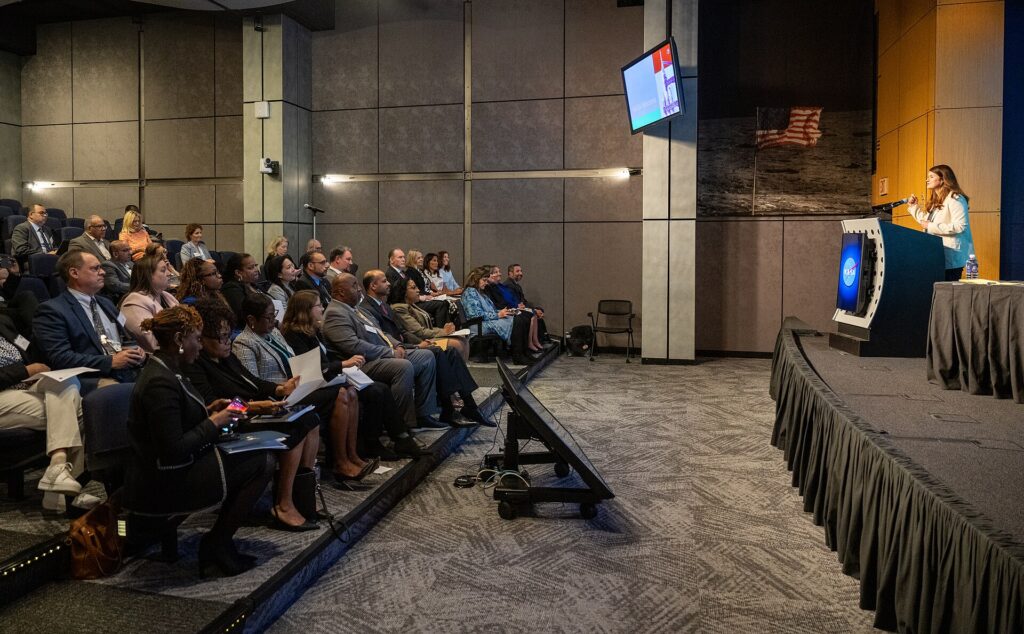
Photo: NASA Headquarters / NASA/Keegan Barber · Public domain · via Wikimedia Commons